Life Dashboard · Personalized report
You took the screen. Here is what it means.
Your stress and your burnout are two different signals. This report reads them together, finds where the load actually sits, reads each of your six facets, and gives you a four-week recovery plan built around your pattern, with a two-week log.
Checkout was canceled, and nothing was charged.
Built from your saved results · ready about a minute after checkout.
Last reviewed
A few pages from a worked example
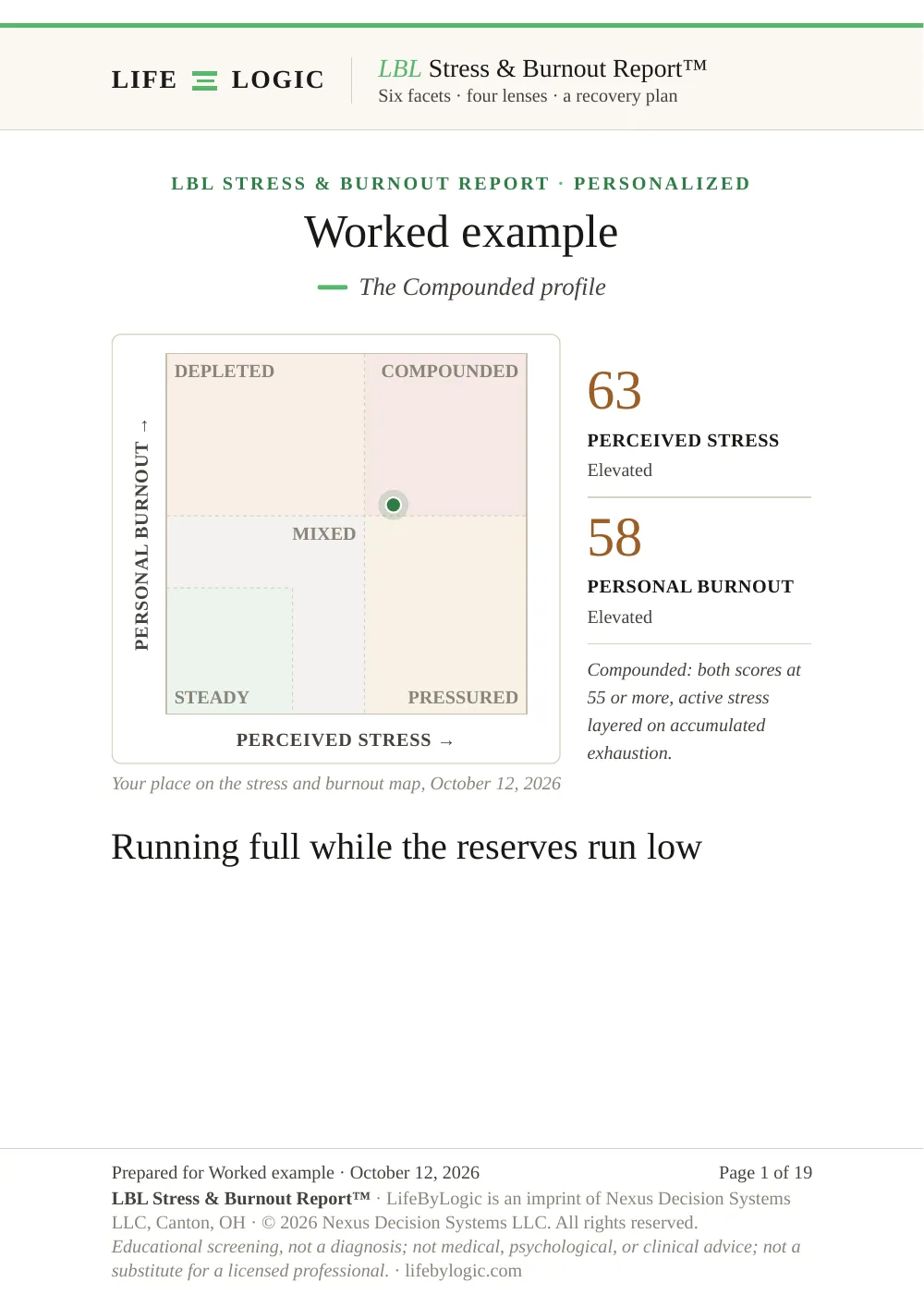
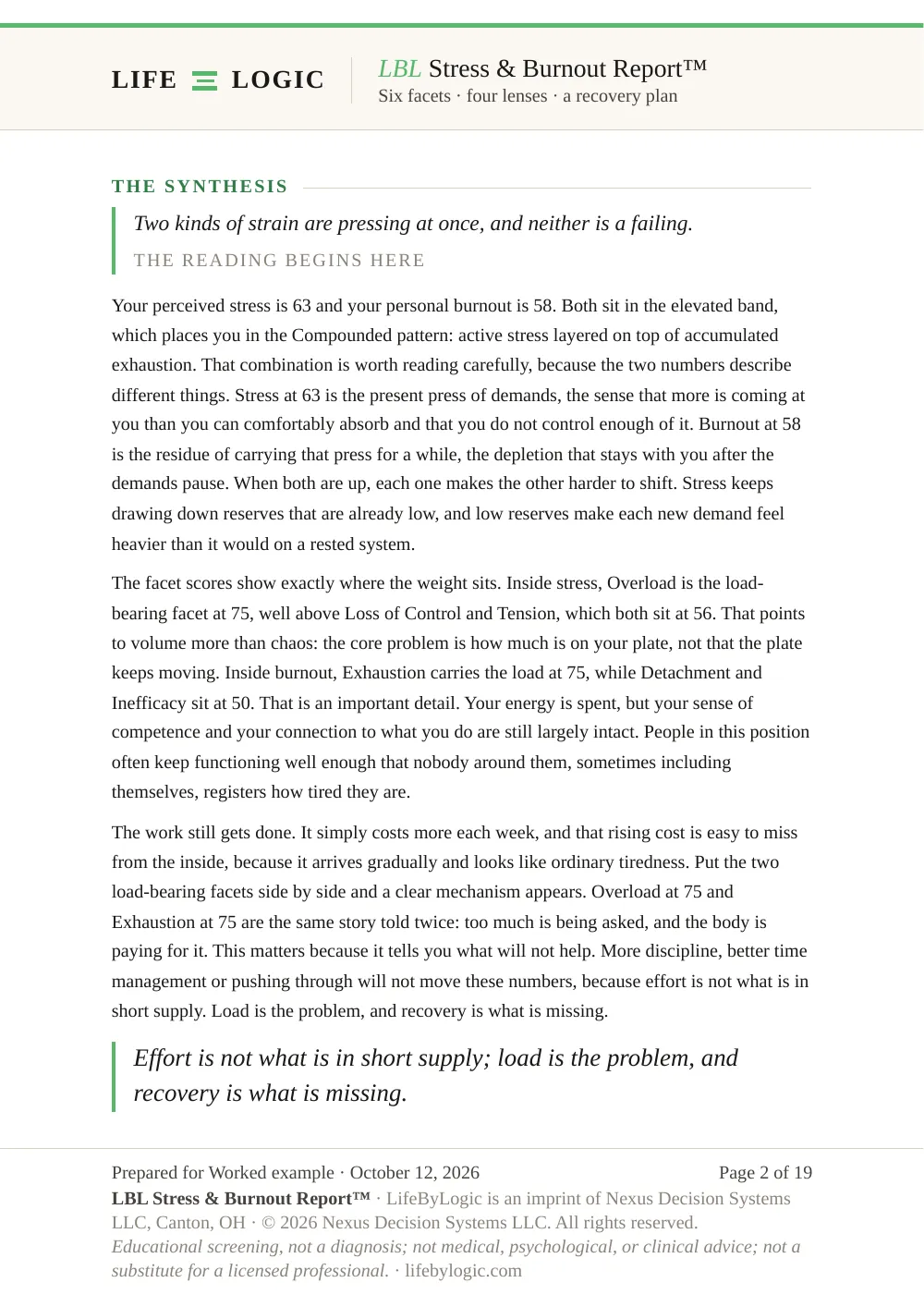
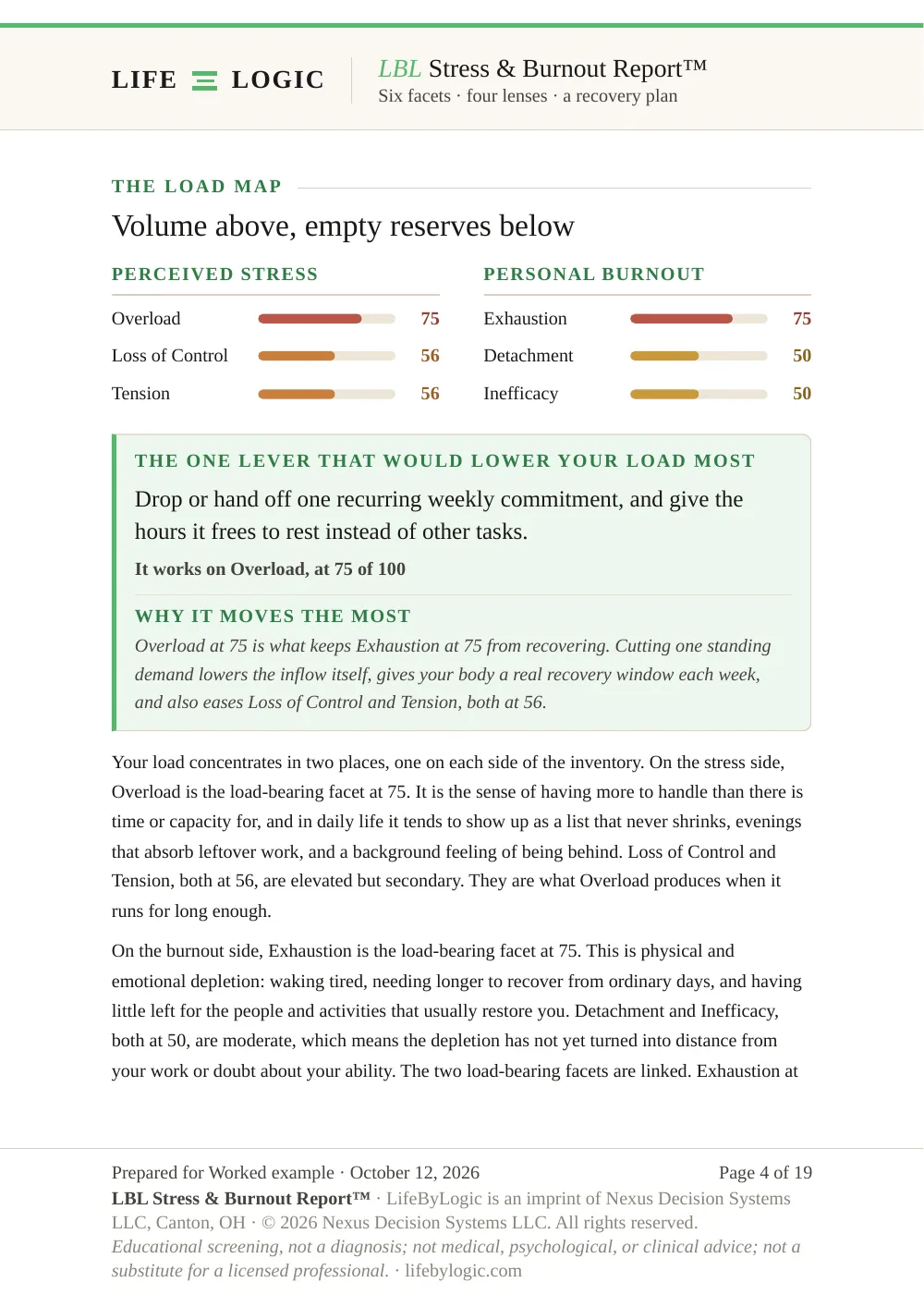
A finished report of about 19 pages for an example result: the Compounded profile, with perceived stress at 63 and personal burnout at 58, where Overload and Exhaustion carry the load at 75. Yours is written from your own scores. Tap a page to see it full size.
Stress and burnout are not the same thing.
A high-stress, low-burnout week is a completely different situation from low-stress, high-burnout depletion — and they call for different moves. Reading the two against each other is the whole point.
The present press
- How unpredictable, uncontrollable, and overloading things feel right now
- Spikes and settles relatively quickly
- Moves when you change the demand or the appraisal
The cumulative drain
- Exhaustion across all of life, not just work
- Builds slowly, over weeks and months
- In its later stages, the warning signal goes quiet
A reading, a map, and a plan.
Eleven parts, built around your exact results — not a template with your name dropped in.
Your two scores, read together
A close interpretation of what your stress and burnout mean in combination, where you sit, and what that pattern tends to feel like day to day.
Where the weight sits
Which of the six facets are driving each score, with the load-bearing facets named, and the one lever that would lower your load most, with why it would move the most.
Your six facets, one by one
Each facet read on its own from its score, so you can see what is driving the load and what is still holding.
Four ways of reading the load
Your pattern seen through stress physiology, the appraisal model, burnout-and-role research, and recovery science.
Four weeks, sequenced to you
Concrete, low-effort recovery moves, week by week, each with a signal — and a built-in recheck-and-escalate at the end.
Words for hard moments
What to say, to yourself or to someone else, in four moments your scores make harder.
Your load and recovery log
Two weeks, one line a day: your load, your energy, time fully off, and what drained or restored you.
Reading this honestly, and retaking
What your scores can and cannot tell you, and a table to fill in at the week 4 recheck and four weeks later.
A standing note on support
When to involve a professional, and a reminder that seeking help is ordinary and wise.
When rest is not enough
When to see a doctor or a mental-health professional, what long strain can show in the body, and where to turn in a crisis.
Five questions worth your honesty
Non-leading prompts about your relationship to load, rest, and limits — the kind worth sitting with rather than answering fast.
Grounded in the science of strain.
Each lens surfaces something the others cannot.
Stress physiology
Allostatic load and the stress-response system (McEwen; Lupien). Why recovery is a physiological requirement, not an indulgence.
Appraisal & coping
The transactional model (Lazarus & Folkman). The two honest levers — changing the demand, or changing the appraisal — and which one your pattern points to.
Burnout & role context
Burnout as a mismatch between demands and resources (Maslach; Job Demands-Resources), not a personal deficit.
Recovery science
What actually restores (Sonnentag on psychological detachment; sleep regularity). The difference between rest that recovers and rest that does not.
This is an educational screening interpretation, not a diagnosis, and not a productivity tool. It is built to help you recover, not to optimize you.
If your responses suggest you are carrying more than you can safely hold, the report is not offered for that result — the free Index and this page route you to support and resources rather than a checkout. If the load feels like too much right now, please reach a primary-care or mental-health professional, or call or text 988 in the US at any time.
From screen to plan in minutes.
Take the free Index
The LBL Stress and Burnout Inventory takes about 6 minutes. Your results save to your browser.
Check out
One-time $24.99. No account to create, nothing to remember.
Get your report
Written from your saved results the moment checkout completes, and delivered as a PDF.
Good to know.
Is the report actually personalized?
Yes. Every reading is written from your specific stress and burnout scores, your six facet scores, and your archetype — not a generic ebook with your name on it.
Is this a diagnosis?
No. It is an educational screening interpretation, not a clinical assessment. If your scores are high or persistent, the report says plainly that a primary-care or mental-health professional is the right next step.
Do I need to retake the inventory?
No. Your results from the free Index are saved in your browser and carry straight over. If you have not taken it yet, it takes about 6 minutes.
How do I get the report after I pay?
Your report is written from your saved results as soon as your checkout completes, and it opens on screen as a PDF, usually in about a minute. A copy is also emailed to the address you give at checkout, or to another address you add while it is written, with a download link that lasts 30 days. There is no account to create.
Is my data private?
Your individual responses are never sold. For its analysis, we send the results your report needs, never your name or email address, to Anthropic, whose Claude model is our analysis tool. The privacy policy has the details.
How is the report made?
Your report is an advanced analysis and synthesis of your own results. Within a framework designed by the LifeByLogic team, an AI model, Anthropic’s Claude, is the analysis tool: it is given only your scores and the framework, and no one reviews a report by hand before it reaches you.
Can I get a refund?
If your report fails to generate, or you do not find it useful and ask within 7 days of buying it, we refund you in full. A report that fails is refunded automatically, and you don't need to ask. To ask for a refund, write to hello@lifebylogic.com.