Family Lab · Personalized plan
Turn screen friction into a family media plan.
The free Family Screen Balance Index gives your family’s screen rhythm and the guidance for your child’s age. The personalized plan opens your balance map and turns it into each area read one by one, age-specific guidance, clear boundaries, scripts for hard moments, a way to talk it through together, and routines that protect sleep, play, and family connection.
Checkout was canceled, and nothing was charged.
Last reviewed
See it before you buy
A few pages from a worked example
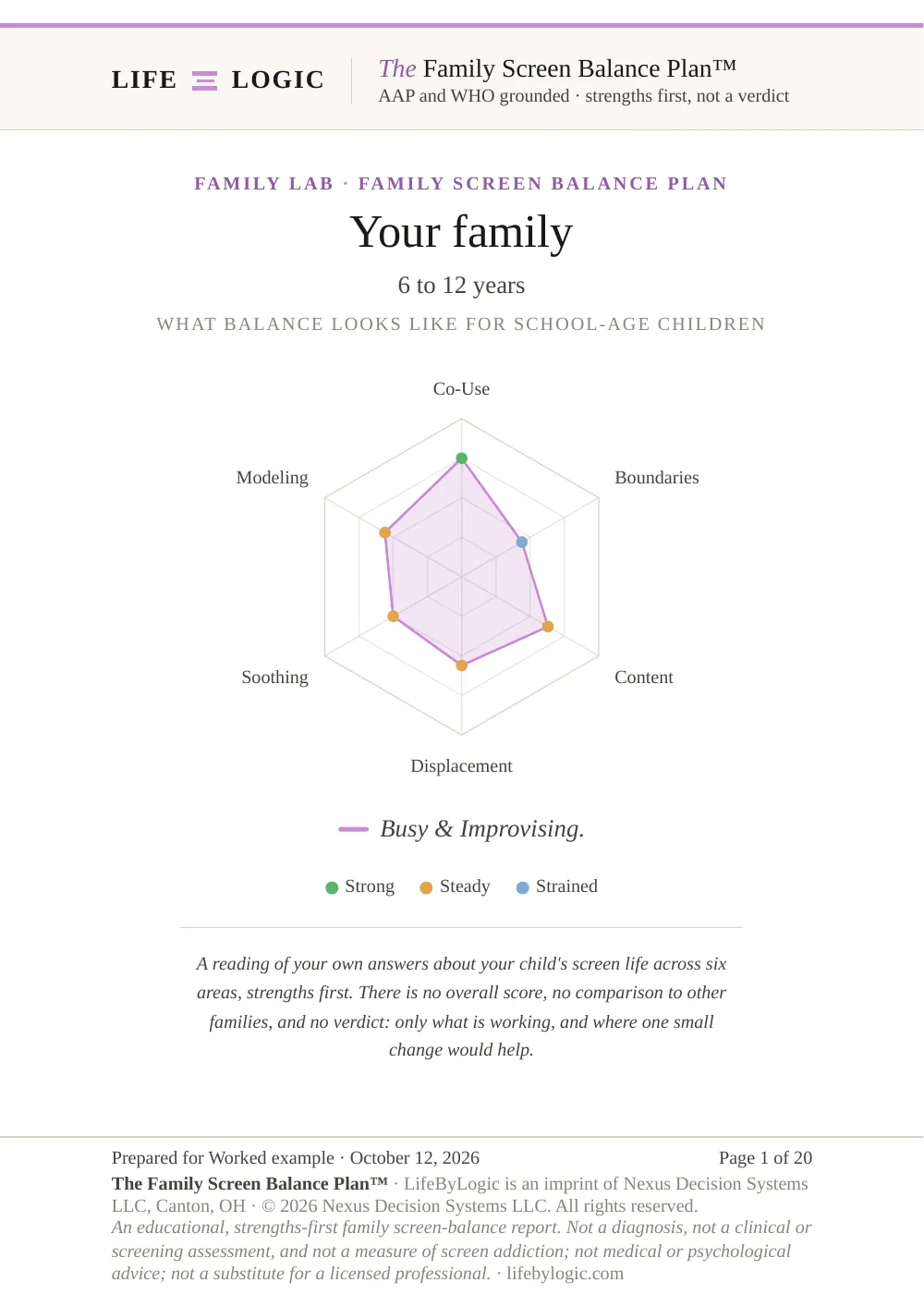
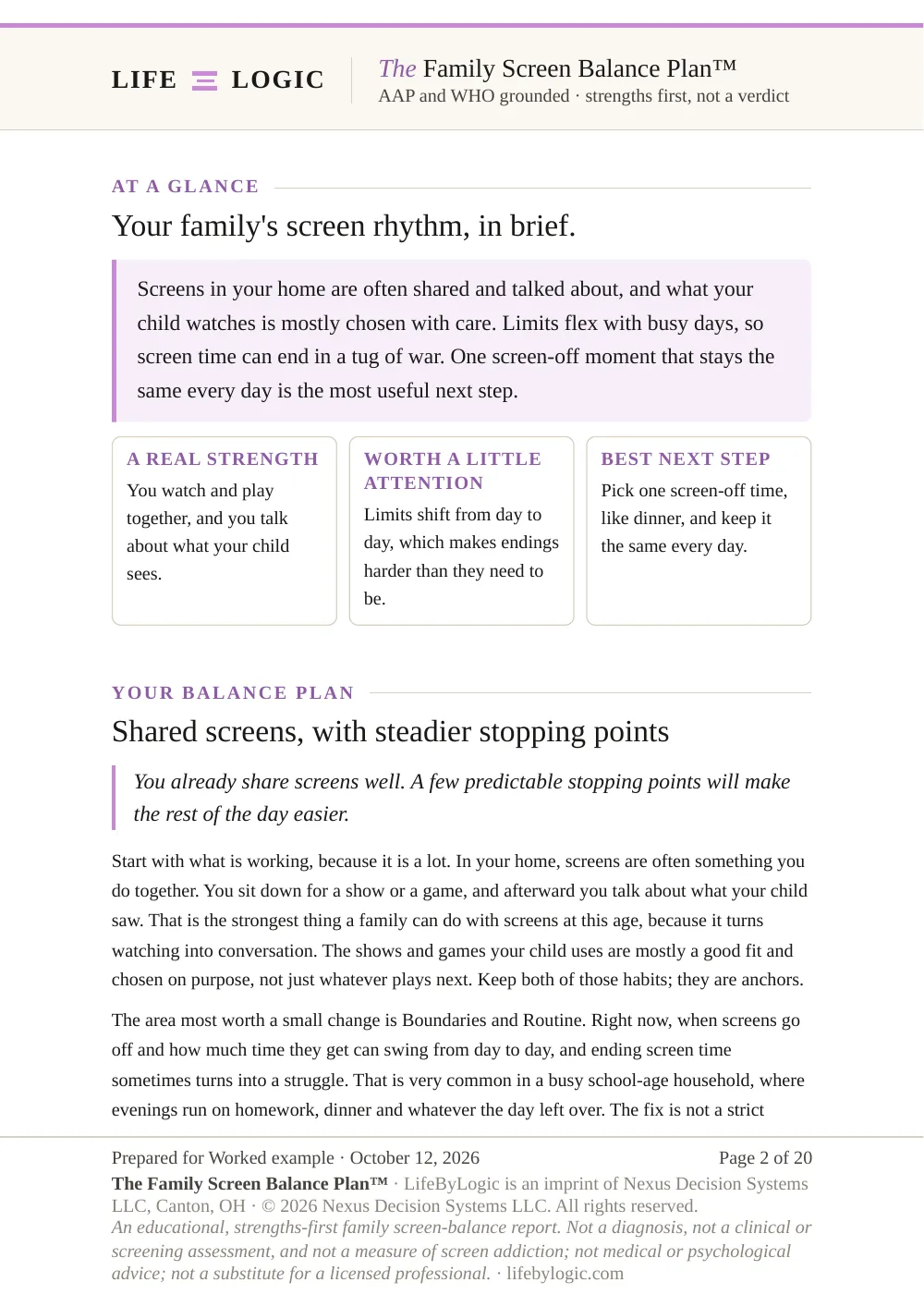
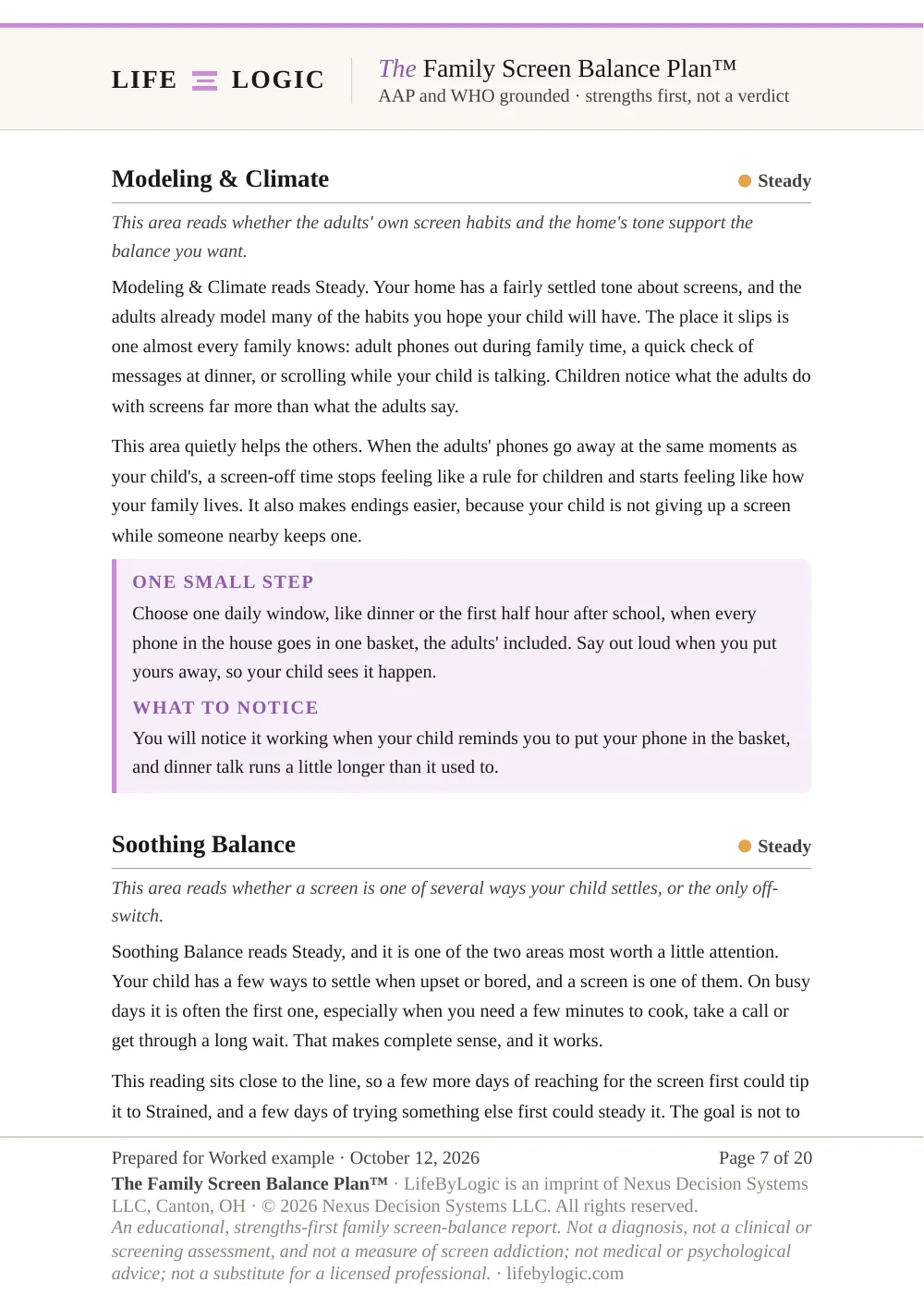
A finished report of about 20 pages for an example result: a family with a child aged 6 to 12, Busy & Improvising, with co-use strong and boundaries the most strained. Yours is written from your own result. Tap a page to see it full size.
Free rhythm vs personalized plan
See your screen rhythm free. Buy the printable plan only if useful.
The report is not about screen addiction or grading your parenting. It translates your screen ecosystem into practical next steps.
Always free
Your family’s screen rhythm and the guidance for your child’s age.
Personalized plan
Your balance map, each area’s band and three practical moves, opened on your result, with a personalized screen balance plan, age-specific guidance, fill-in family media plan, scripts, and sleep-protecting routines.
What you get
A practical screen-balance plan, written from your family's result.
Screen balance plan
A plain-language plan across co-use, boundaries, content, displacement, soothing, and modeling.
Age-specific guidance
What balance looks like for under 2, preschool, school-age, or teen families.
Family media plan
A fill-in structure for when, where, what, and how screens fit into the week.
Scripts for hard moments
What to say when screen time ends, limits are tested, or transitions get loud.
Sleep protection
Gentle, age-fitted routines for sleep, mealtimes, and downtime.
A two-week experiment
One small change aimed at your family's most strained area, two weeks to try it, and what to notice.
The six areas, one by one
All six areas read in turn, strengths first, each with one small step to try and what to notice.
Talking it through together
One calm talk to bring the plan to your child, in four steps with words to start, and your two-week media log to see what changes.
Reading this honestly, and re-checking
What your answers can and cannot tell you, a table for checking again, five questions to think over, and when to seek help from your pediatrician or a child psychologist.
Ready when the screen map matters
One-time purchase. Personalized printable PDF. Secure checkout after your free result. If your report fails to generate, or you do not find it useful and ask within 7 days of buying it, we refund you in full.
Start the free balance check →Questions
Before you buy
Is this about screen addiction?
No. It is about balance: whether screens are shared, bounded, good quality, and not crowding out sleep, play, learning, or connection.
What is the difference between free and paid?
The free tool gives your family’s screen rhythm and the guidance for your child’s age. Buying the plan opens the balance map and first moves on your result, and the PDF gives the age-fitted plan, scripts, family media plan, and routines.
Is my data private?
The tool runs in your browser. If you buy the report, we send the results and answers the analysis needs, never your name or email address, to Anthropic, our analysis provider, and we delete them a day after your PDF is made. See our privacy policy for details.
How is the report made?
Your report is an advanced analysis and synthesis of your own results. Within a framework designed by the LifeByLogic team, an AI model, Anthropic’s Claude, is the analysis tool: it is given only the framework and the results and answers the analysis needs, and no one reviews a report by hand before it reaches you.