You saw the shape of your attachment. Now get the map.
You took the Attachment Style Decoder and saw your two-dimension result. This report is an advanced analysis and synthesis of those exact scores: what your anxiety and avoidance actually mean for how you love, how your pattern shows up in real relationships, and the growth path toward earned security, written for you.
Checkout was canceled, and nothing was charged.
Last reviewed
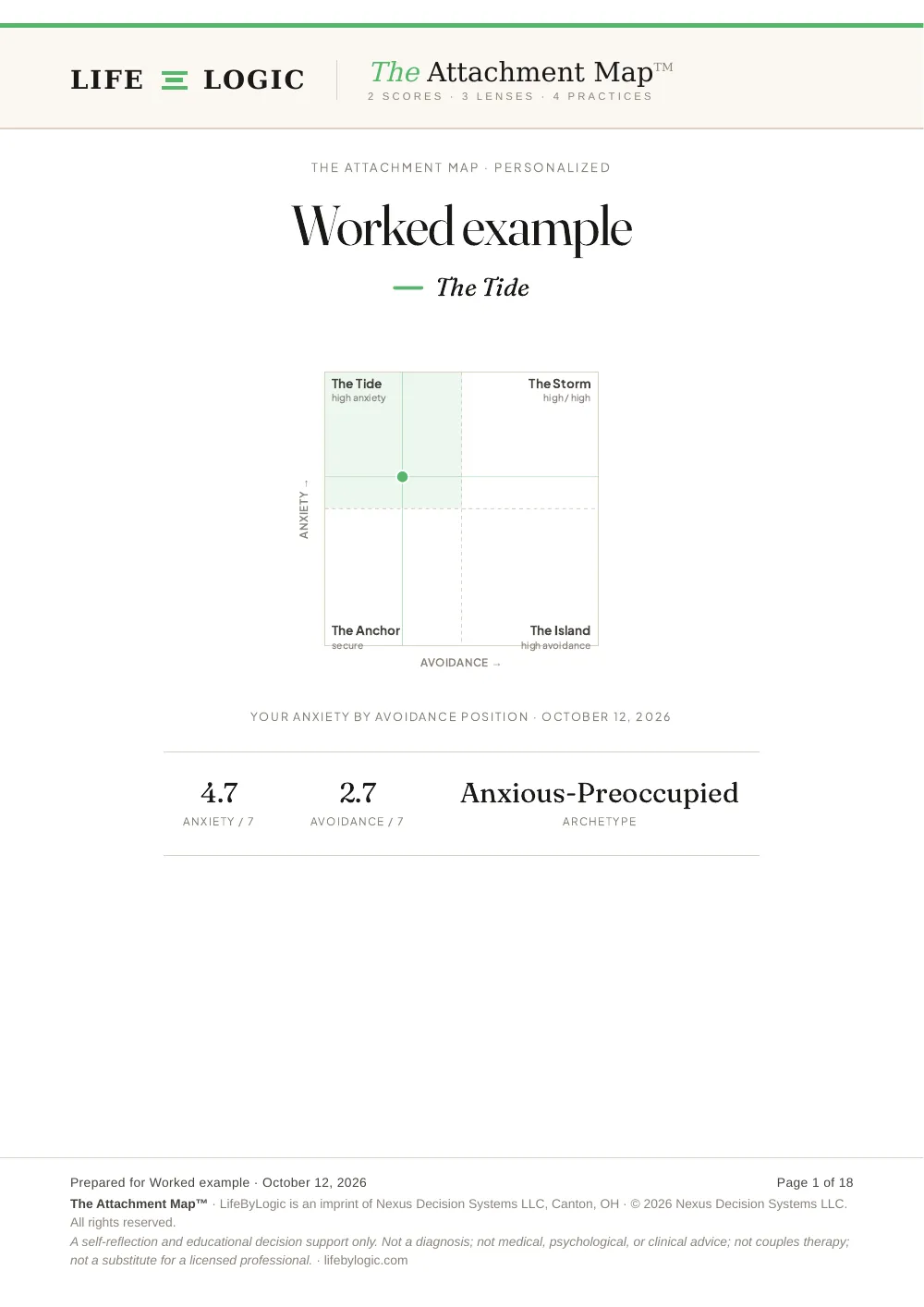
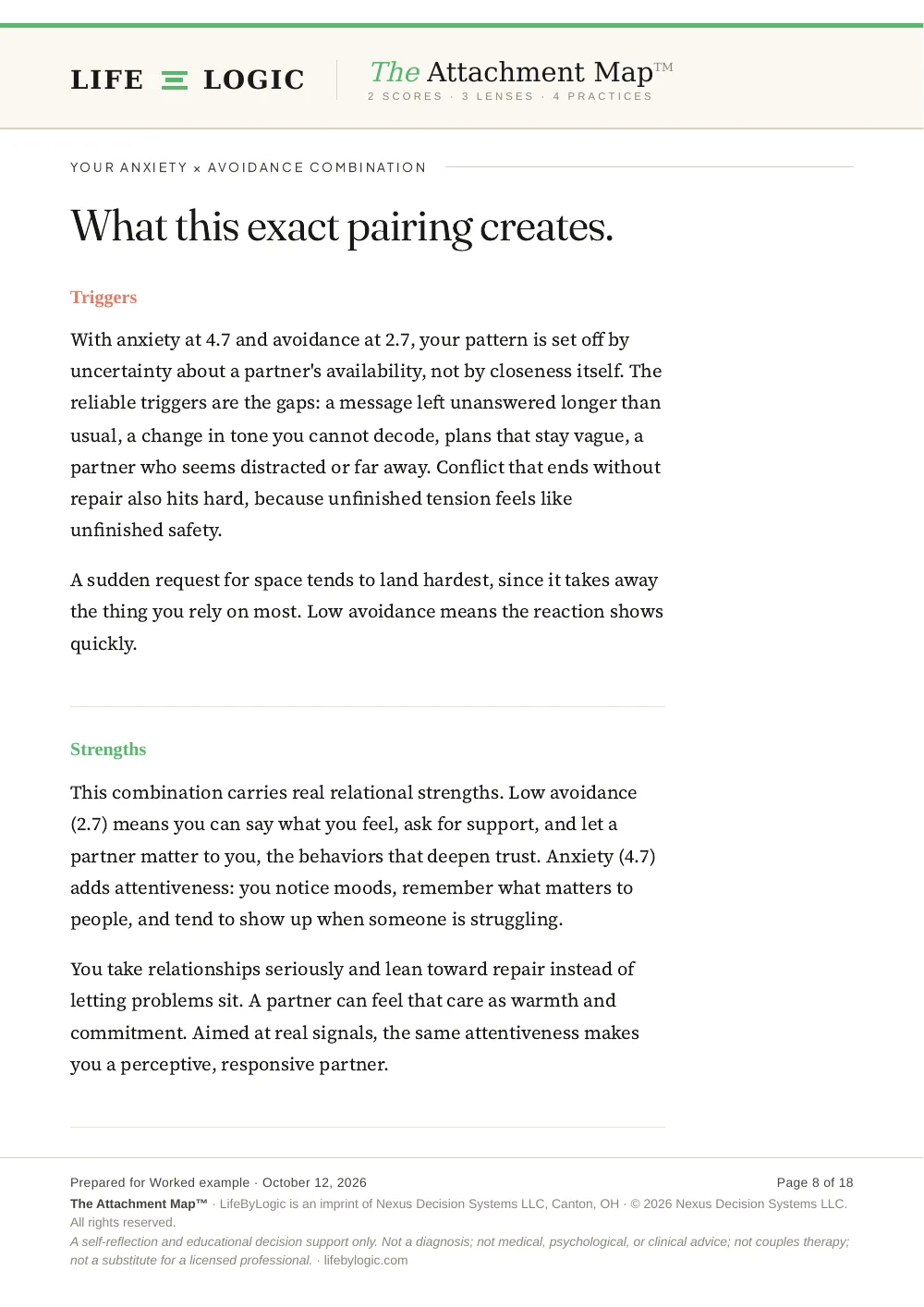
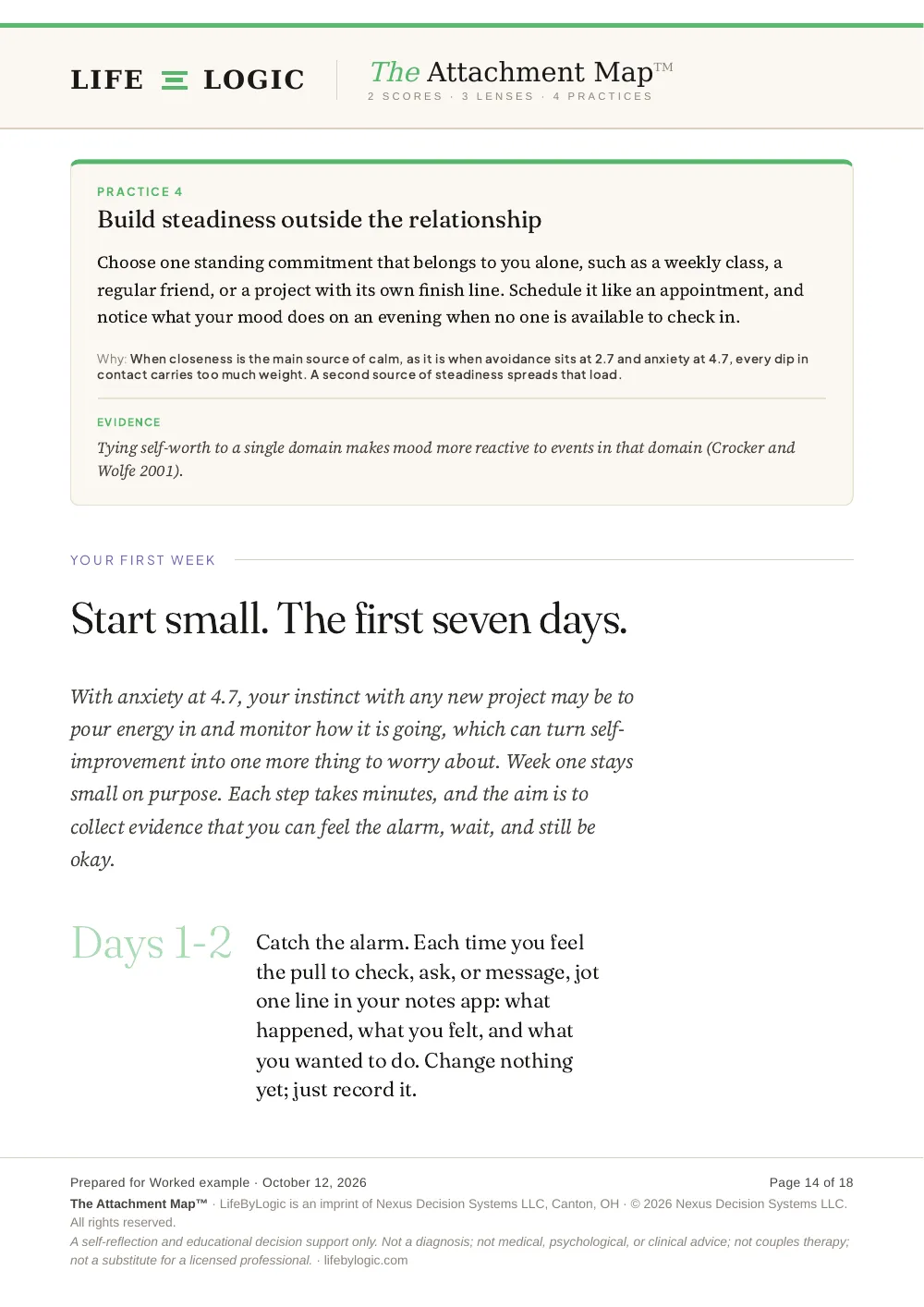
Three pages from a worked example
A finished report for an example result: the Tide, with anxiety at 4.7 and avoidance at 2.7 out of 7. Yours is written from your own two scores. Tap a page to see it full size.
What's in your report
Written from your specific profile. No generic boilerplate; every paragraph is written from your two scores and your archetype.
The Synthesis
A close reading of your Attachment Anxiety and Attachment Avoidance scores, and what their specific configuration means for how you actually move through closeness, conflict, and distance, including the cross-currents between them.
Your Two Dimensions
A read of each score on its own: what your level of anxiety, and your level of avoidance, looks like in practice, and the mechanism underneath each, so the number becomes something you understand.
How It Shows Up
The concrete, personalized patterns: how your specific profile plays out under conflict, when a partner pulls close or pulls away, and in the quiet moments that reveal the most.
Your Anxiety × Avoidance Combination
What your exact pairing creates: the situations that most reliably activate it, the genuine strengths it carries, and the internal tension that comes with it.
Three Lenses
Attachment theory, the nervous system, and relational dynamics each read your two scores and surface something the others do not, each ending in a question worth sitting with.
Your Growth Path & First Week
What earned security would look like for your profile, four specific practices in the order to try them with the evidence behind each, and a first week in three small steps.
Reflection Prompts
Five questions written for your specific pattern, designed to sit with rather than answer quickly.
Built on the Attachment Style Decoder, an LBL-original instrument grounded in the two-factor model of adult attachment (Brennan, Clark & Shaver 1998; Fraley 2002; Mikulincer & Shaver 2007). Theory-grounded and documented, but not a validated clinical measure. A self-reflection report and educational decision support, not a diagnosis and not couples therapy.
Common questions
Do I need to retake anything?
No. Your results carry over automatically from the free decoder you already took. The report uses your existing two-dimension profile and archetype.
How is it delivered?
On screen as a PDF, in about a minute after you pay. A copy is also emailed to the address you give at checkout, or to another address you add while it is written, with a download link that lasts 30 days.
Is this a diagnosis or therapy?
No. It is an educational decision-support tool for reflection. Attachment style describes how you tend to move in close relationships; it is not a clinical condition, and this is not a diagnosis and not couples therapy. Where it describes options like therapy, it describes the published evidence base as background; it does not prescribe treatment.
How is the report made?
Your report is an advanced analysis and synthesis of your own results. Within a framework designed by the LifeByLogic team, an AI model, Anthropic’s Claude, is the analysis tool: it is given only your scores and the framework, and no one reviews a report by hand before it reaches you.
Is my data private?
Your individual responses are never sold. For its analysis, we send the results your report needs, never your name or email address, to Anthropic, whose Claude model is our analysis tool. The privacy policy has the details.
What if the report fails to generate?
If your report fails to generate, we refund you in full, and we handle any other refund request case by case. A report that fails is refunded automatically, and you don't need to ask.