Family Lab · Personalized report
Turn your family rhythm score into a daily plan.
The free Family Rhythm Index gives the score. The personalized report explains the pattern: what is steady, what is strained, and how to rebuild mornings, evenings, bedtime, screen transitions, and connection rituals, with words for the other hard switches in your day, without trying to fix the whole family at once.
Checkout was canceled, and nothing was charged.
Last reviewed
See it before you buy
A few pages from a worked example
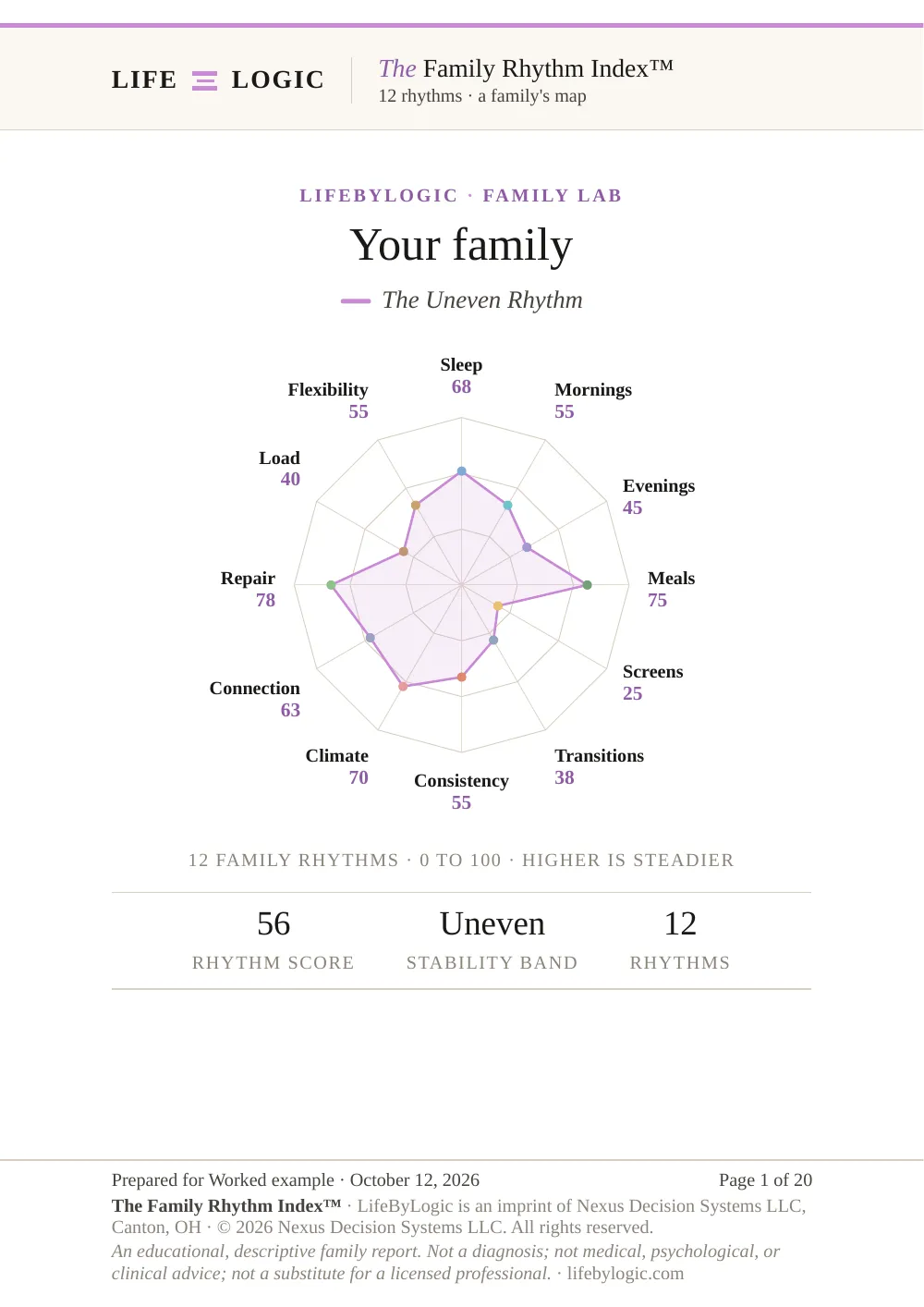
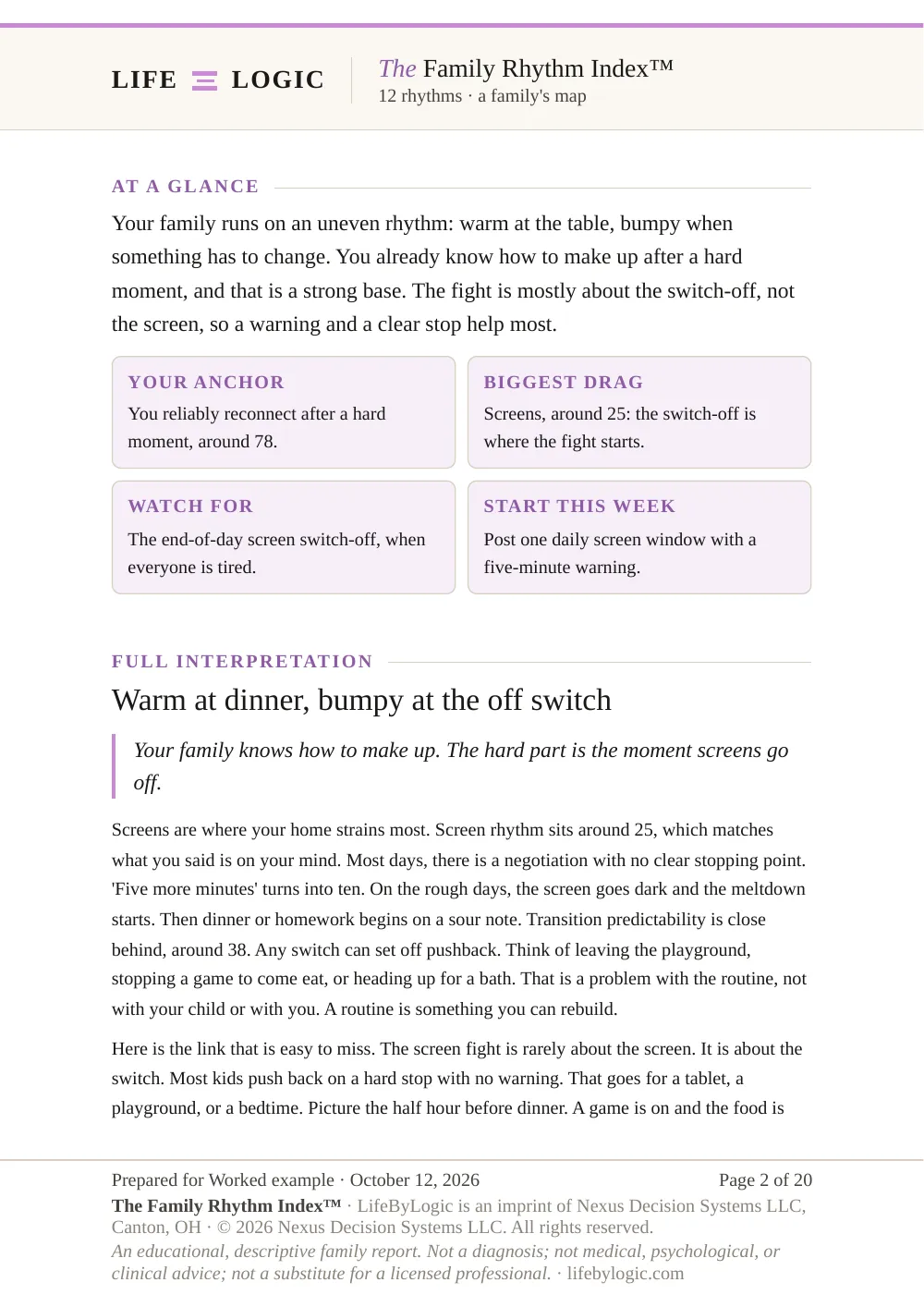
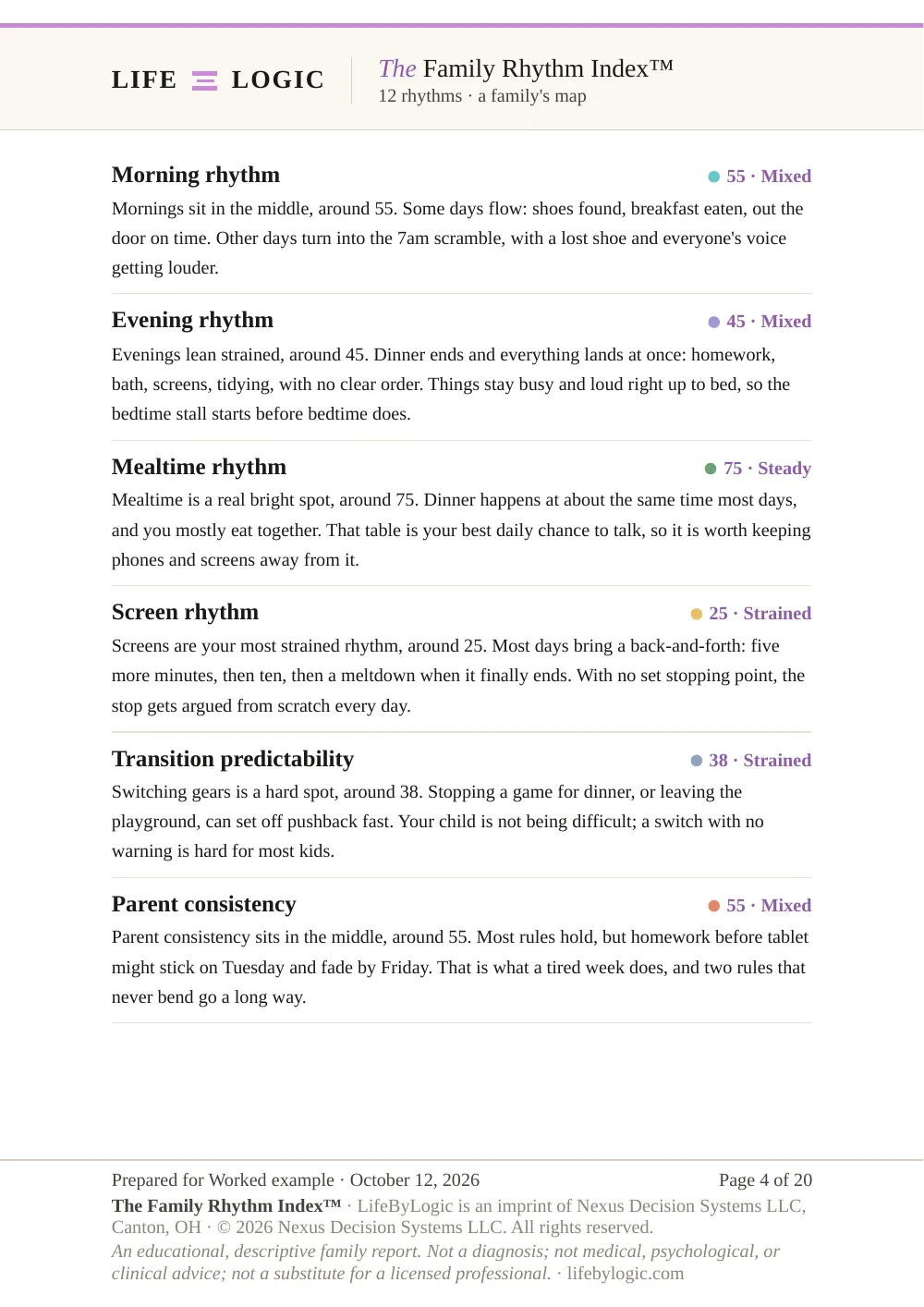
A finished report of about 20 pages for an example result: the Uneven Rhythm at 56 out of 100, with screen rhythm the weakest at 25. Yours is written from your own result. Tap a page to see it full size.
Free result vs personalized report
See the numbers free. Buy depth only if the result matters.
The report is not sold blind. You first complete the Family Rhythm Index and see your overall score, 12 dimension scores, and stability band.
Always free
Your rhythm score, dimension radar, stability band, and immediate summary.
Personalized report
A personalized interpretation, routine plans, printable rhythm map, checklist, rituals, screen transition plan, and 30-day reset path.
What you get
A practical household operating manual, written from your result.
12-rhythm interpretation
Sleep, mornings, meals, screens, transitions, connection, and repair interpreted in plain language.
Routine plans
Morning, evening, and bedtime plans built around your weakest rhythm, starting with mornings or bedtime when that is what you said is most on your mind.
Screen transition plan
Scripts and structure for ending screen time with less bargaining and escalation.
Family ritual builder
Small repeated moments that turn structure into warmth and belonging.
Weekly rhythm map
Three or four short stops across your week, such as a Sunday reset, a midweek check, and a plan for after a hard day, each fitted to your family.
30-day reset plan
Four weeks of small, steady changes, one focus a week, weighted toward your lowest-scoring rhythms.
Transition scripts
Words for six hard switches in your day beyond the screen, from your lowest rhythms: what to say before, when it is time, and if it stalls.
Reading this honestly, and re-checking
What the twelve scores can and cannot tell you, and a table to fill in when you take the index again after 30 days and after three months.
When to talk to someone
When sleep, meltdowns, low mood or tension at home are worth taking to a pediatrician, a child psychologist or a family therapist, and where to turn in a crisis.
Ready when your result matters
One-time purchase. Personalized printable PDF. Secure checkout after your free result. If your report fails to generate, or you do not find it useful and ask within 7 days of buying it, we refund you in full.
Start the free Family Rhythm Index →Questions
Before you buy
Do I need the free result first?
Yes. Your report analyzes your own Family Rhythm Index result, so you see the score and all 12 dimensions before paying.
What is the difference between the free tool and the PDF?
The free tool gives the figures and summary. The PDF gives routines, scripts, printables, and a 30-day reset plan.
Is this clinical?
No. It is educational family decision support. It does not diagnose or treat any child, parent, or household.
How is the report made?
Your report is an advanced analysis and synthesis of your own results. Within a framework designed by the LifeByLogic team, an AI model, Anthropic’s Claude, is the analysis tool: it is given only the framework and the results and answers the analysis needs, and no one reviews a report by hand before it reaches you.