You saw the shape of your profile. Now read what it means.
You took the Adult Autism Self-Inventory and saw your result across four trait areas plus masking and emotional processing. This report takes those exact scores and writes the interpretation: what your specific pattern means day to day, how masking changes the reading, and where to start, written for you.
Checkout was canceled, and nothing was charged.
Last reviewed
Three pages from a worked example
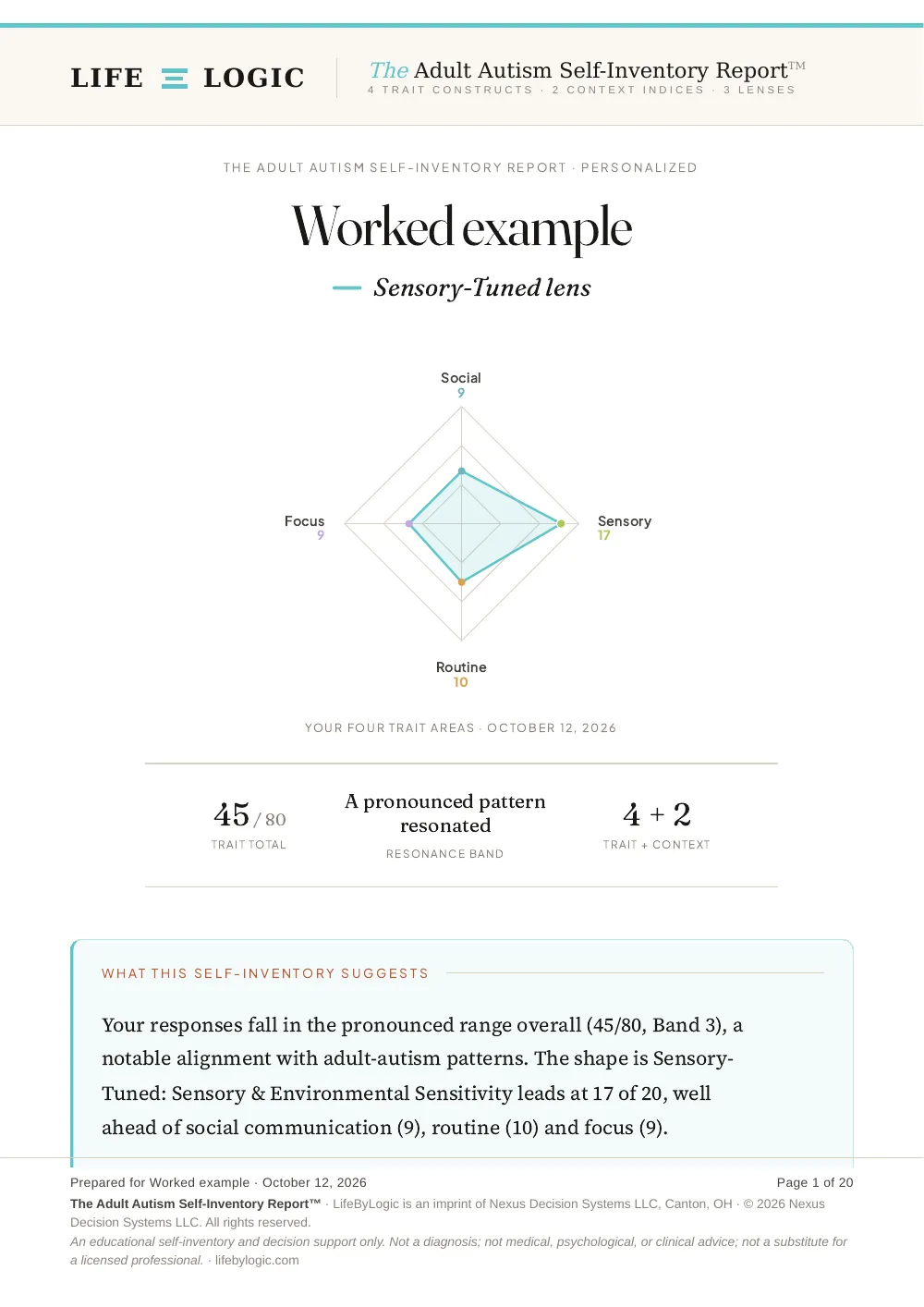
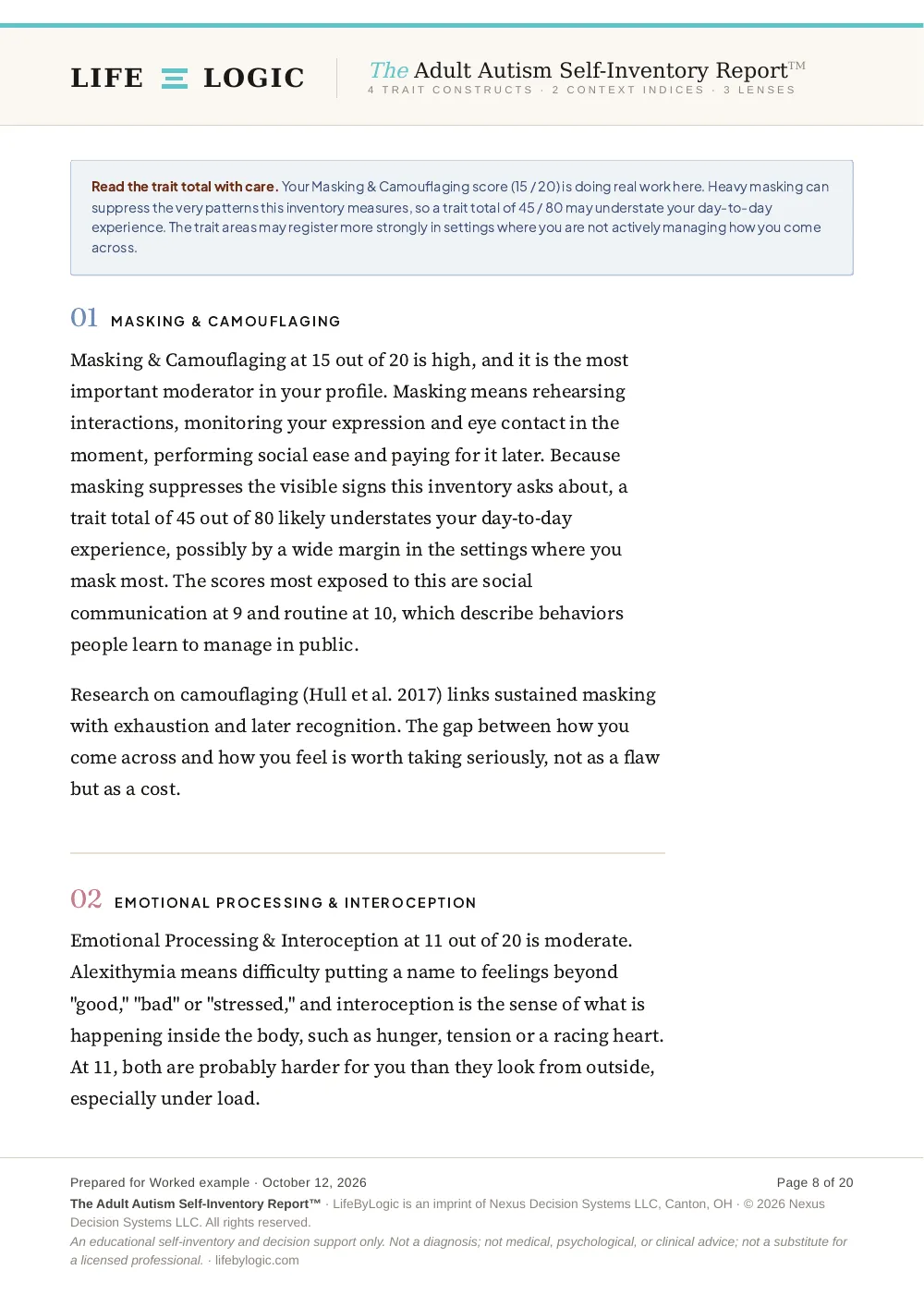
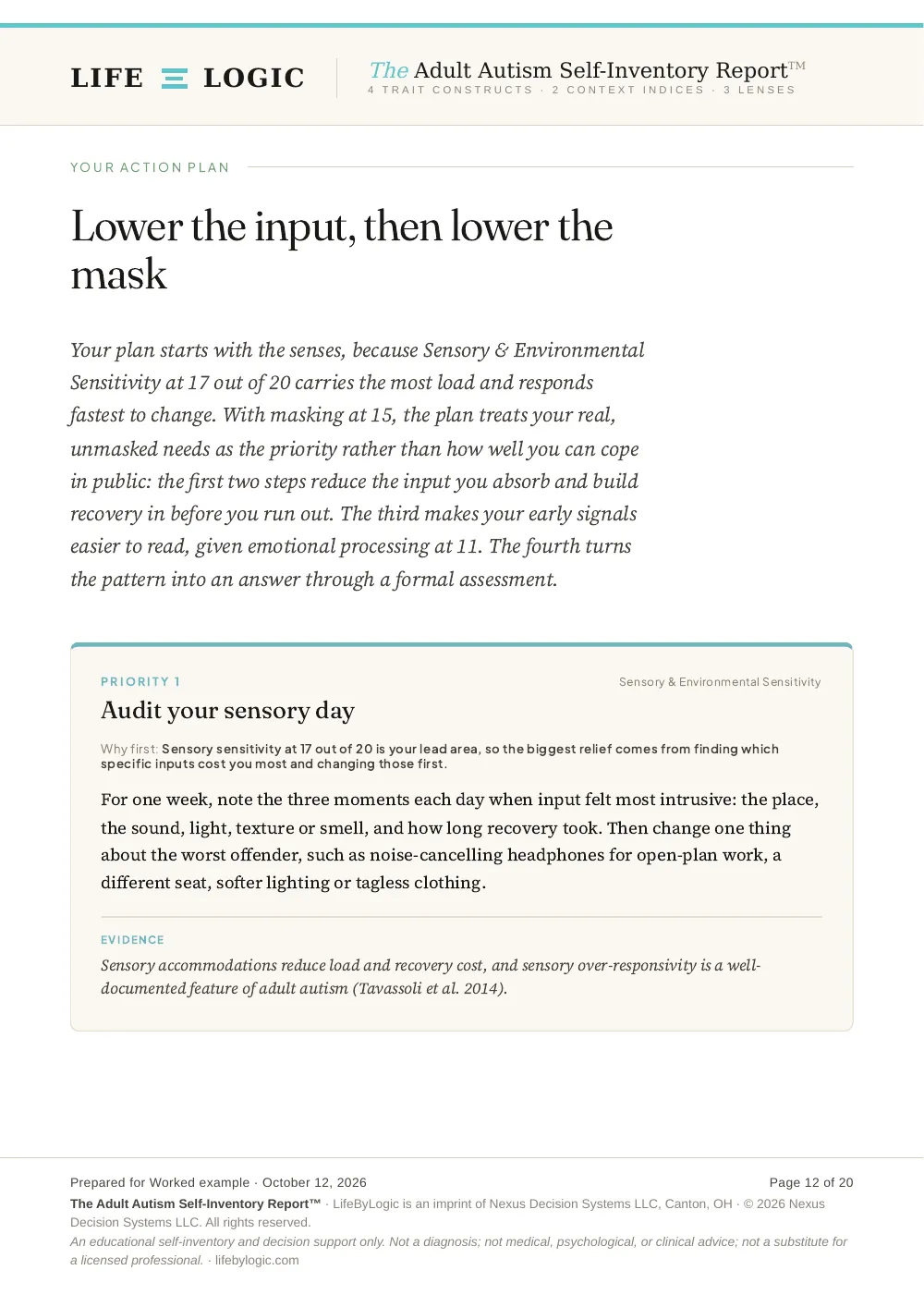
A finished report for an example result: the Sensory-Tuned lens, a trait total of 45 of 80 with sensory sensitivity at 17 of 20, masking at 15 and emotional processing at 11. Yours is written from your own scores. Tap a page to see it full size.
What's in your report
Generated from your specific profile. No generic boilerplate; every paragraph is written from your scores and your lens.
The Synthesis
A close reading of your Social, Sensory, Routine, and Focus scores and what their specific configuration means for how you move through work, relationships, and daily life, including the cross-currents between them and how masking changes the picture.
Your Four Trait Areas
A construct-by-construct read of each score: what your level looks like in practice, and the mechanism underneath it, so the number becomes something you actually understand.
Two Context Indices
Masking and Camouflaging, and Emotional Processing and Interoception, read as moderators rather than trait scores, with a clear flag when heavy masking means your trait total likely understates your experience.
Three Research Lenses
Clinical science, cognitive science, and lived experience each read your profile and surface something the others do not, each ending in a question worth sitting with.
Your Four Supports, in Order
Four supports ordered by what to do first for your pattern, framed around accommodation and self-understanding, each with a rationale tied to your scores, one concrete step and the research behind it.
Your First Week
Three small steps to start with, sized for your profile.
Next Steps & The Overlap Picture
The honest guidance for your profile: whether a formal assessment makes sense, what it involves, and which overlapping or look-alike conditions (anxiety, ADHD, trauma, burnout) are worth considering.
Reflection Prompts
Five questions written for your specific pattern, designed to sit with rather than answer quickly.
Built on the Adult Autism Self-Inventory (LBL-AAS v2.0), an LBL-original instrument grounded in the adult-autism research literature (Lai, Lombardo & Baron-Cohen 2014; Hull et al. 2017; Tavassoli et al. 2014; Bird & Cook 2013). A self-inventory report and educational decision support, not a diagnosis.
Common questions
Do I need to retake anything?
No. Your results carry over automatically from the free self-inventory you already took. The report uses your existing six-construct profile and lens.
How is it delivered?
On screen as a PDF, in about a minute after you pay. A copy is also emailed to the address you give at checkout, or to another address you add while it is written, with a download link that lasts 30 days.
Is this a diagnosis or a medical assessment?
No. It is an educational decision-support tool and a structured self-inventory. It does not diagnose, treat, or screen for any condition, and it is not a substitute for a licensed professional. A high score is a signal worth a clinical conversation, not a conclusion. A formal autism diagnosis requires a clinician to assess developmental history and functional impact.
What if the report fails to generate?
If your report fails to generate, we refund you in full, and we handle any other refund request case by case. A report that fails is refunded automatically, and you don't need to ask.