Family Lab · Personalized report
Understand the child in front of you — without boxing them in.
The free Child Temperament Profile gives the 12-dimension figure. The personalized report explains what that profile means: how your child's style shows up in everyday life, where their strengths are, what kind of support fits, what to say in the hard moments and when others need to understand them too, and a two-week log to see what helps.
Checkout was canceled, and nothing was charged.
Last reviewed
See it before you buy
A few pages from a worked example
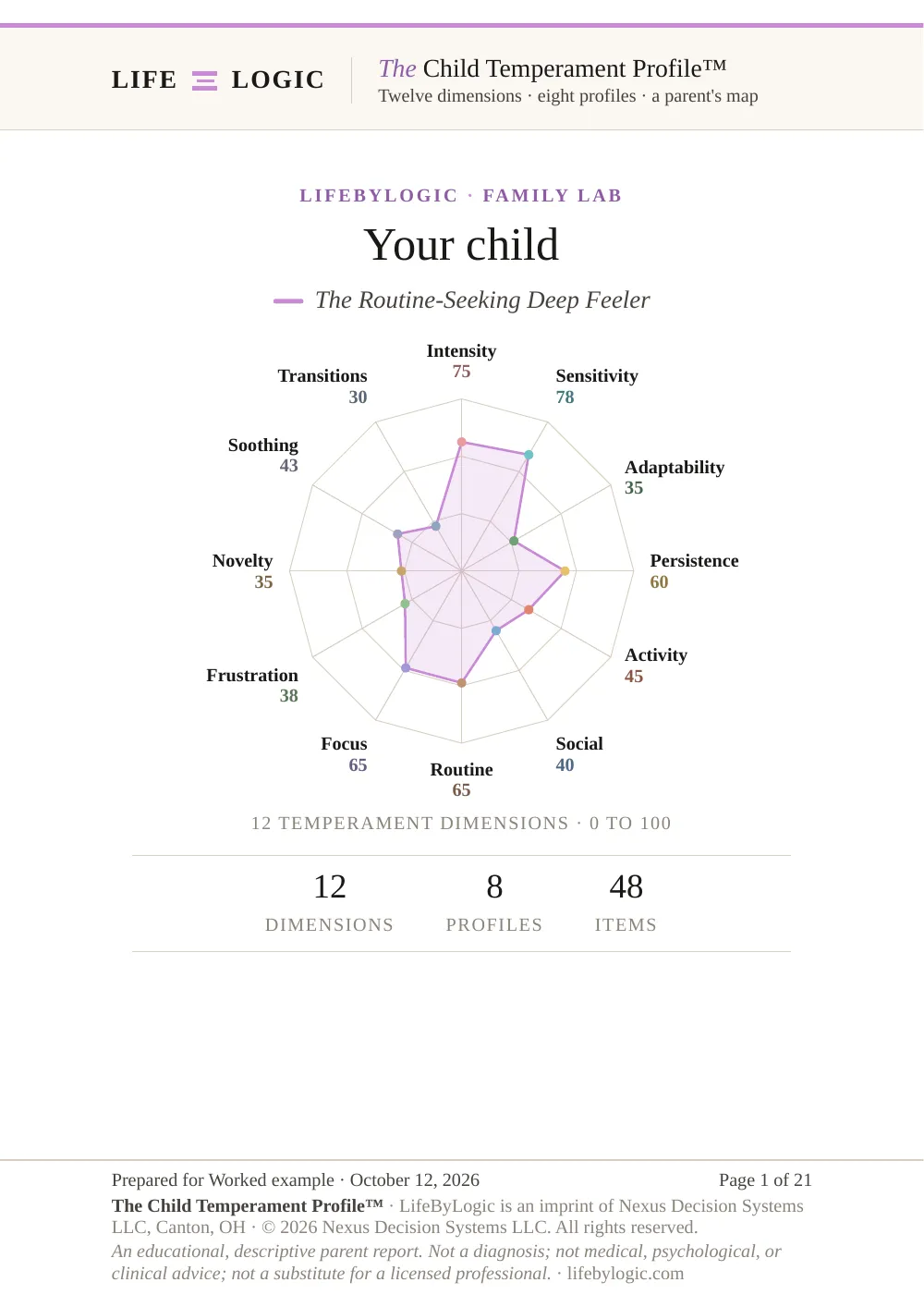
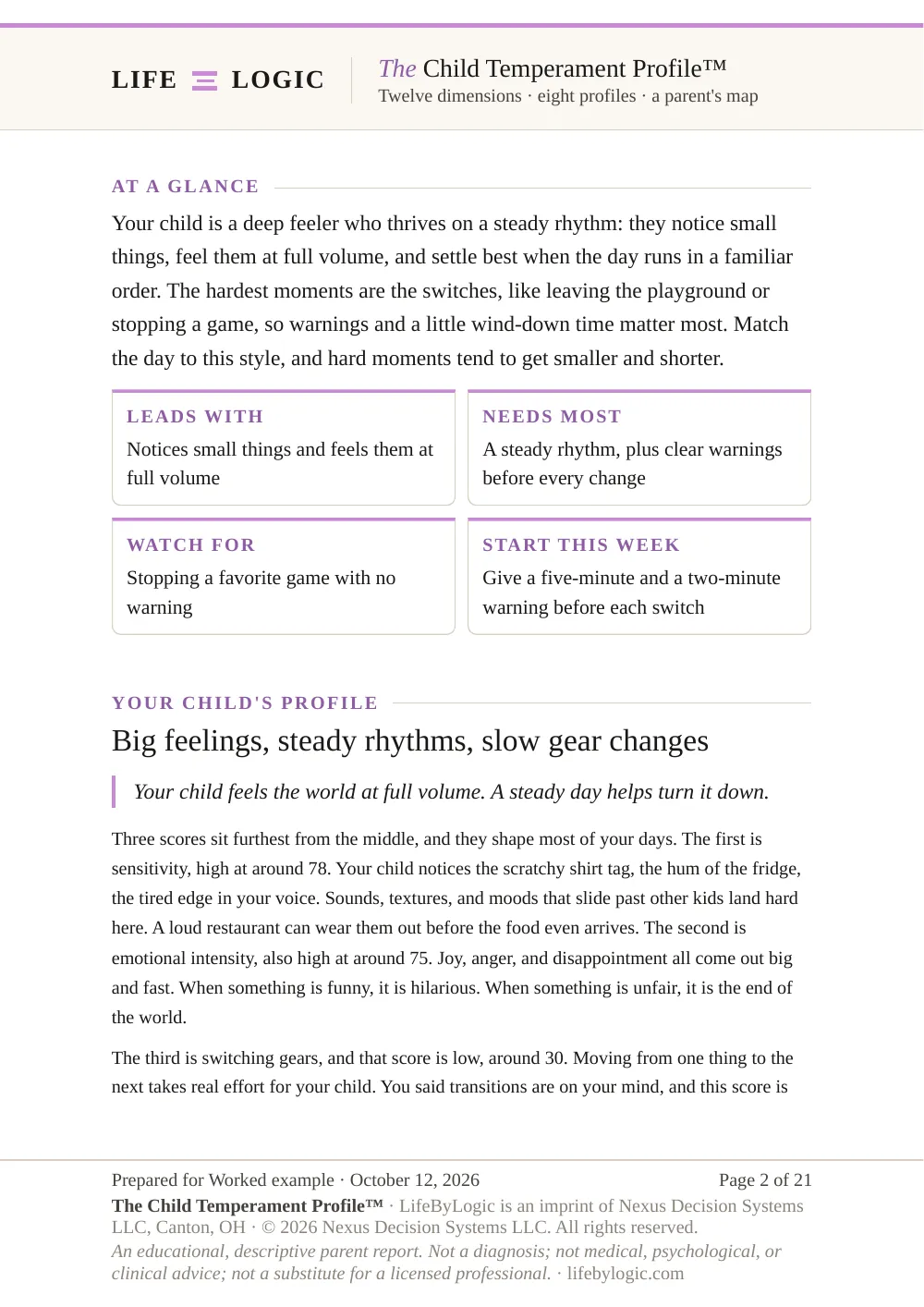
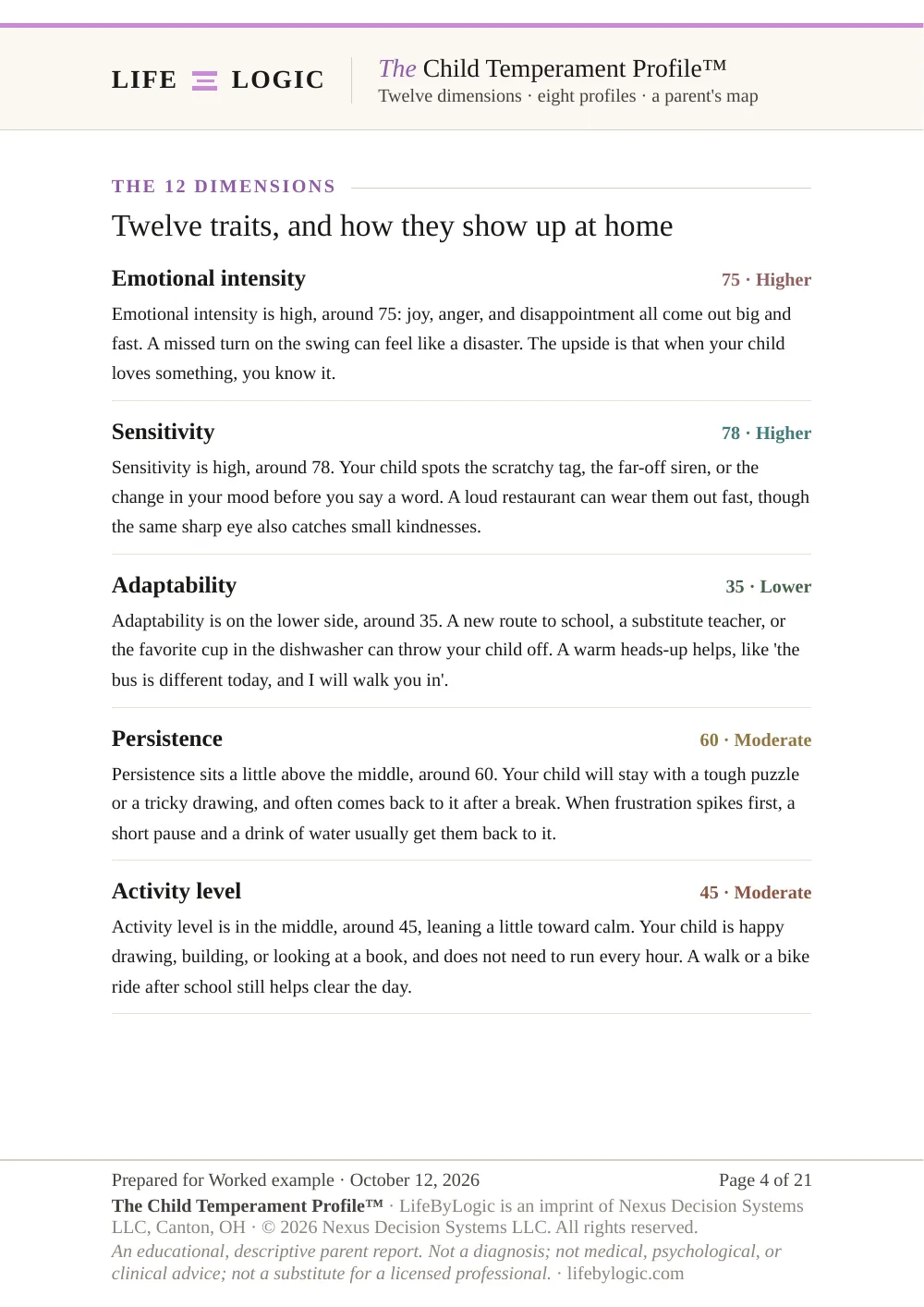
A finished report of about 21 pages for an example result: a Routine-Seeking Deep Feeler aged 5 to 7, whose parent said transitions and routines are most on their mind. Yours is written from your own result. Tap a page to see it full size.
Free profile vs personalized report
See the temperament figure free. Buy the interpretation only if it helps.
The report is not sold blind. You first complete the Child Temperament Profile and see the shape of your child's 12 dimensions.
Always free
Your child's profile figure, 12 dimension scores, and immediate temperament summary.
Personalized report
A deeper reading of the pattern, strengths, support needs, scripts for caregivers, and a fitted 30-day plan.
What you get
A practical temperament guide, written from your child's result.
12-dimension interpretation
Activity, adaptability, emotional intensity, sensitivity, persistence, social approach, and more explained in everyday language.
Strengths and strain points
Where your child's style is already an asset, and where the environment may need adjustment.
Support playbook
Three or four concrete supports fitted to your child's scores, starting with what you said is most on your mind.
Three research lenses
How developmental psychology, pediatric health research, and early-childhood education research each read the profile, without pretending to diagnose.
Scripts to share
Plain-language phrases for teachers, relatives, co-parents, sitters, and caregivers.
30-day support plan
Four small changes, one a week, fitted to your child's profile.
Words for hard moments
What to say to your child in six moments their profile makes harder, starting with what you said is most on your mind, and why each line helps.
Your 14-day observation log
Two weeks, one line each evening, to try the first two weeks of your plan and see what helps.
Reading this honestly, and retaking
What the twelve scores can and cannot tell you, a table for when you retake the profile, and when to seek help from your pediatrician or a child psychologist.
Ready when the profile matters
One-time purchase. Personalized printable PDF. Secure checkout after your free profile. If your report fails to generate, or you do not find it useful and ask within 7 days of buying it, we refund you in full.
Start the free Child Temperament Profile →Questions
Before you buy
Do I need the free profile first?
Yes. Your report analyzes your own Child Temperament Profile result, so you see the 12-dimension result before paying.
Is this diagnostic?
No. It is an educational parent guide to temperament. It does not diagnose, screen for, treat, or rule out any condition.
Will this label my child?
No. The report names your child's current pattern, such as a Routine-Seeking Deep Feeler, as a short way to talk about it, not as a fixed type or a diagnosis. It describes patterns that may help you adjust support, expectations, and communication.
How is the report made?
Your report is an advanced analysis and synthesis of your own results. Within a framework designed by the LifeByLogic team, an AI model, Anthropic’s Claude, is the analysis tool: it is given only the framework and the results and answers the analysis needs, and no one reviews a report by hand before it reaches you.