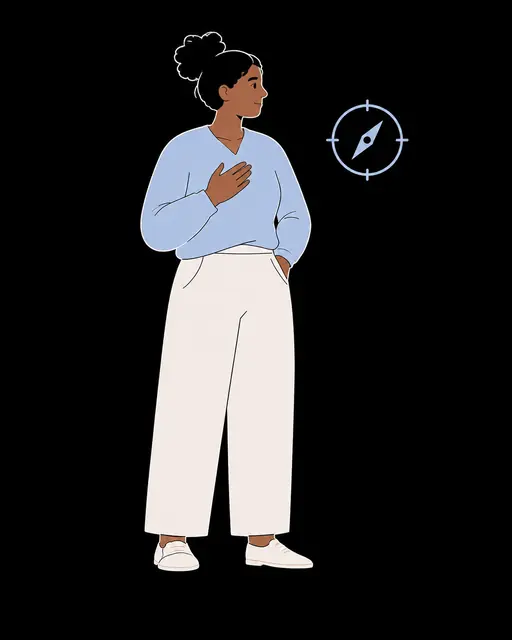
The INFJ is the type people describe before they have the word for it: the friend who knew something was wrong before you said it, the colleague who is quiet in the meeting and then says the one thing that reframes the whole problem, the person who seems gentle until you cross a line they will not move on. In the Personality Type Test map this profile is named the Oracle — not because INFJs predict the future, but because they live a step ahead of the present, reading where people and situations are heading and feeling responsible for it. It is a rare way to be wired, and a frequently misunderstood one.
This guide is built around the seven dimensions TypeAtlas reports on — career, relationships, communication, conflict, stress, money, and growth — because a personality type is only useful when it touches the actual decisions of a life. Throughout, one rule holds: these are tendencies, not destiny. A type describes the path of least resistance for your attention and energy, not a ceiling on who you can become.
§I.Who the INFJ really is
Four trait axes combine to produce the INFJ pattern. Introversion (I) means energy is restored alone and spent in company — INFJs are sociable but pay an energetic tax for it. Intuition (N) means attention runs toward meaning, patterns, and implications rather than concrete detail; an INFJ in a room is half-tracking what is literally happening and half-tracking what it means. Feeling (F) means decisions are weighed against values and human impact before abstract logic. And Judging (J) means the outer life is organised, planned, and brought to closure rather than left open.
What makes the INFJ feel paradoxical is the specific collision of those four. The Feeling preference makes them warm and people-centred; the Judging preference makes them structured and decisive. Most warm types are flexible and most structured types are cool — the INFJ is both warm and structured, which reads as "soft on the surface, steel underneath." They will absorb a great deal to keep the peace, and then reach a values line that is simply non-negotiable. People who only met the accommodating version are genuinely startled by the immovable one.
The recognised strengths of the type cluster around insight and conviction: an unusual ability to understand other people's inner states, to synthesise messy information into a coherent picture, to hold a long-term vision, and to act on principle even when it costs them. The recognised growth edges are the same traits turned up too high: a tendency to over-give and then quietly burn out, perfectionism aimed at an impossible internal standard, conflict-avoidance that lets small problems grow, and a habit of retreating into the inner world instead of testing ideas against reality. None of this is fixed. It is simply where this particular wiring tends to drift under load.
One honest caveat before we go further. TypeAtlas measures four continuous axes, not four switches — you might be clearly Introverted but only mildly Judging. If any of your axes sits near the middle, read the adjacent type too; a "borderline J" INFJ will recognise a great deal of the INFP (the Poet) in themselves. The four-letter code is a useful shorthand for a position on four sliders, nothing more.
§I½.How the INFJ is often mistyped
Because the INFJ pattern is rare and internal, it is one of the most frequently mistyped profiles — and clearing up the confusion is one of the fastest ways to recognise the real thing. The most common mix-up is INFJ vs INFP. Both are warm, idealistic intuitive feelers, but the INFP (the Poet) leads with an internal value system and lives more comfortably with open ends, while the INFJ (the Oracle) organises the outer world toward a vision and feels a pull to bring things to closure. INFPs tend to ask "does this fit my values?"; INFJs tend to ask "where is this heading, and what needs to happen?" If your Judging–Perceiving axis sits near the middle, you will recognise yourself in both, and that ambiguity is information, not error.
The second common mix-up is INFJ vs INTJ. Both are introverted, intuitive, future-oriented planners who can seem private and intense, but the deciding axis is Feeling versus Thinking. The INFJ filters decisions through human impact and values first; the INTJ (the Strategist) filters through logic and system efficiency first. An INFJ who has spent years in an analytical career can look strikingly INTJ on the surface — until you watch what they actually optimise for under pressure. When the four-letter code feels uncertain, the underlying axis positions, with their confidence scores, are far more informative than the label.
§II.INFJ careers: best-fit work and what to avoid
The best careers for an INFJ share three ingredients: meaning (the work has to matter, not just pay), autonomy (room to work in their own way, without constant supervision or open-plan noise), and depth (the chance to go deep on a problem or a person rather than skating across many at once). Give an INFJ a mission they believe in and the latitude to pursue it, and you get someone who works with quiet relentlessness. Put them in a high-volume, transactional, politically performative role and they wilt, regardless of the salary.
Grounded in occupational data, the roles that recur for this profile fall into a few families. For an interest-based career map, see our guide to Holland codes and the six RIASEC career types. In helping and developing people: counsellors and therapists, clinical and counselling psychologists, social workers, and student or career advisors — work that rewards reading people and holding confidences. In meaning-making and ideas: writers and editors, UX researchers, librarians, professors and instructional designers, and roles in mission-driven non-profits. In health and care: physicians in patient-centred specialties, occupational and speech therapists, and palliative or mental-health nursing. And in people-centred parts of organisations: HR and learning-and-development specialists, DEI and people-operations roles, and one-to-one coaching. What unites them is one-to-one or small-group depth, a clear human purpose, and protected focus time.
Just as useful is knowing the anti-fit. INFJs tend to struggle in cut-throat sales, high-frequency trading floors, rigid bureaucracies that punish initiative, and any role whose core is relentless small talk, surface networking, or selling things they do not believe in. The drain is not the difficulty — INFJs handle hard — it is the values mismatch and the lack of quiet. A common INFJ career arc is to climb a "sensible" ladder for a decade, hit a wall of meaninglessness, and pivot hard toward something that matters. Naming that early can save years.
A practical note on advancement: the INFJ allergy to self-promotion is the single biggest career tax this type pays. The work is often excellent and quietly invisible. Learning to document impact, claim credit without discomfort, and ask directly for what they want is, for most INFJs, worth more than any additional skill.
§III.INFJ relationships: love, friendship, and compatibility
In relationships the INFJ runs deep and narrow. They want a small number of profound connections rather than a wide social field, and they are willing to invest enormously in the few that count. In romance they are loyal, attentive, and unusually attuned — an INFJ partner often notices a shift in your mood before you have registered it yourself. The flip side is high standards and a long runway: INFJs are slow to open the innermost door, screen quietly for authenticity, and can idealise a partner and then feel quietly disappointed when reality arrives.
The recurring relationship pattern to watch is the "door slam," the INFJ habit of withdrawing completely from someone who has repeatedly violated their trust. It looks sudden from the outside, but it is almost always the end of a long, unspoken accounting — resentment that built silently because the INFJ avoided the smaller conflicts along the way. The antidote is not lowering standards; it is raising the volume on small, early honesty so nothing has to accumulate to the point of rupture.
On compatibility, the popular pairings put INFJs with intuitive partners who can meet them in the world of meaning — the ENFP, ENTP, and INTJ are the classically cited matches. But TypeAtlas's honest position is worth repeating here: type does not predict relationship success. Shared values, communication skill, security, and effort matter far more than a four-letter compatibility chart. The most useful thing type offers a couple is not a verdict on whether they "should" be together, but a shared language for why they each react the way they do under pressure.
§IV.INFJ communication style
INFJs are often most articulate in writing. Given time and a page, they are precise, layered, and persuasive; put on the spot in a fast verbal exchange, the same person may go quiet while they search for the exact right phrasing. This is not a lack of thought — it is the opposite, a perfectionism about words. They communicate through meaning and metaphor, prefer one deep conversation to an evening of small talk, and read tone and subtext so automatically that they sometimes respond to what you meant rather than what you said.
The blind spot is indirectness. Because INFJs feel others' reactions so vividly, they often soften, hint, and circle rather than stating a need plainly — and then feel unseen when the hint is missed. The single most valuable communication upgrade for this type is direct, low-drama clarity: naming a need as a simple fact rather than hoping it will be inferred. When an INFJ learns to say "I need an hour alone to recharge" instead of withdrawing and hoping to be understood, most of their relational friction quietly drops.
§V.INFJ conflict style
The default INFJ stance toward conflict is avoidance — not from cowardice but from an acute sensitivity to disharmony and a tendency to absorb tension as physical discomfort. They will accommodate, smooth, and self-silence to keep a relationship intact. This works until it doesn't: unaddressed grievances accumulate behind the calm surface until the INFJ hits a values threshold, at which point the accommodating posture can flip to a startling, immovable firmness.
Handled well, the INFJ is a genuinely gifted mediator — able to see every side, name the real issue underneath the surface argument, and hold space for strong feeling without escalating. The growth move is to engage conflict earlier and smaller, while issues are still minor and emotion is still low, rather than waiting until a quiet ledger of resentments forces a rupture. For INFJs, conflict avoided is rarely conflict resolved; it is usually conflict postponed and compounded.
§VI.INFJ and stress: triggers and recovery
INFJs are reliably worn down by a specific set of conditions: prolonged conflict or disharmony, environments that violate their values, overstimulating or chronically noisy settings, too little solitude, and the slow erosion of over-giving without replenishment. Because they monitor everyone else's emotional state, they often arrive at their own depletion last — aware that the people around them are okay long before they notice that they themselves are not.
Under severe or sustained stress, the characteristically intuitive, people-attuned INFJ can flip into an uncharacteristic mode: obsessive focus on physical details, sudden indulgence or compulsive behaviour, harsh self-criticism, or a cold withdrawal from the very people they care about. The practical recovery toolkit is consistent: protected solitude that is scheduled rather than improvised, a small number of trusted confidants, creative or reflective outlets (writing, music, nature, journaling), and — crucially — firm boundaries on how much of other people's emotional weight they agree to carry. INFJ burnout is usually a boundary problem wearing a workload costume. If stress is persistent and affecting your daily function, that is a reason to talk to a professional, not a personality quirk to push through.
The TypeAtlas Personality Test
Thirty-two LBL-original statements, four trait axes with per-axis confidence, your closest-fit alternatives, and practical interpretation across all seven life dimensions — careers grounded in O*NET labor-market data, and clear limits on what type can and cannot tell you. Free, runs locally in your browser, no account required.
Take the test →§VII.INFJ and money
Money is the dimension almost no personality resource covers honestly, and it is where the INFJ pattern is genuinely distinctive. For the INFJ, money is rarely about money — it is about meaning, security, and values. They are not natural status spenders and tend to feel actively uncomfortable with conspicuous consumption. Spending follows conviction: an INFJ will hesitate over a small luxury for themselves and then donate generously to a cause, fund a friend's hard moment, or invest heavily in something they believe is meaningful.
The strengths here are real — INFJs are usually thoughtful, future-oriented, and resistant to keeping-up-with-the-neighbours spending. The risks are equally characteristic. Over-giving is the big one: the same generosity that makes them good partners and friends can quietly undermine their own financial security, especially when saying no feels like a failure of compassion. Avoidance is the second: because money can feel grubby or anxiety-provoking, some INFJs simply do not look — leaving budgets vague and decisions unmade. And perfectionism can turn a simple financial choice into an agonising, over-researched one.
The practical move for an INFJ is to put their values to work for their security rather than against it: automate saving so the future self is protected without a monthly act of willpower, set a deliberate and bounded giving budget so generosity is sustainable rather than self-sabotaging, and treat money management as an expression of values (freedom, stability, the ability to help people later) rather than a betrayal of them. If a concrete number would help — how much an automated habit compounds, or what a sustainable giving or retirement figure looks like — our sister project FinCalcs has free calculators for exactly that.
§VIII.INFJ growth: how the Oracle develops
Healthy development for the INFJ runs in one consistent direction: out of the head and into reality, and from over-giving toward sustainable boundaries. The unhealthy INFJ lives almost entirely in the inner world — idealising, ruminating, quietly resentful, perpetually disappointed that the real world does not match the internal vision. The mature INFJ keeps the vision but tests it against reality, says the hard thing early, asks for what they need plainly, and treats their own wellbeing as a non-negotiable rather than the last item on the list.
Three moves do most of the work. First, practise direct honesty in small doses — state needs as facts, not hints. Second, protect solitude on purpose instead of waiting until depletion forces it. Third, act before the picture is perfect — ship the draft, start the project, have the conversation, because reality teaches faster than the inner simulation ever can. Growth does not turn an INFJ into a different person. It turns the over-extended, conflict-avoidant, self-neglecting version into the grounded, boundaried, quietly formidable one the type is capable of being.
A closing reminder, because it is the most important sentence on this page: this is a description of tendencies, not a diagnosis or a destiny. A personality type is a useful map of where your energy and attention naturally run — a way to understand yourself and the people around you with more compassion and less friction. It is not a box, not an excuse, and not a prediction. The most accurate, nuanced picture comes from your own four axes, with their own confidence scores, which is exactly what the test is for.
Common questions about the INFJ.
The questions we hear most often from people who test as INFJ — and from the people trying to understand them.
i.Why is the INFJ called the rarest personality type?
Across large self-report samples, the INFJ pattern — Introverted, Intuitive, Feeling, and Judging together — shows up less often than any other four-letter combination, commonly cited at roughly 1–2 percent of people. The exact figure varies by sample and instrument and should be read as "uncommon," not as a precise statistic. Intuition is the least common preference to begin with, and pairing it with the warm-but-structured F–J combination is rarer still.
ii.What are the best careers for an INFJ?
Roles that combine meaning, autonomy, and one-to-one or small-group depth: counselling and psychology, writing and editing, UX research, teaching and instructional design, healthcare in patient-centred specialties, mission-driven non-profit work, and people-focused roles in HR, learning and development, and coaching. INFJs tend to struggle in cut-throat sales, rigid bureaucracies, and any role built on relentless small talk or selling things they do not believe in.
iii.Who is the INFJ most compatible with?
The commonly cited matches are intuitive partners who can meet the INFJ in the world of ideas and meaning — ENFP, ENTP, and INTJ are the classic pairings. But type does not predict relationship success. Shared values, communication skill, security, and effort matter far more than any compatibility chart. Type is most useful as a shared language for understanding each other under stress, not as a verdict on who you should date.
iv.What is the INFJ "door slam"?
It is the INFJ tendency to withdraw completely and permanently from someone who has repeatedly violated their trust. It looks abrupt, but it is usually the end of a long, silent accumulation of unspoken grievances — the result of avoiding small conflicts until resentment reaches a breaking point. The healthier alternative is earlier, smaller honesty, so nothing has to build to the point of total rupture.
v.Is the INFJ type scientifically valid?
Four-letter type systems are popular and genuinely useful for self-reflection and shared language, but they are not clinical instruments, and the binary-type model has known measurement limits compared with continuous trait models. TypeAtlas reports continuous axes with confidence rather than hard boxes for exactly this reason. Treat your result as a thoughtful starting point for understanding yourself, not as a fixed or diagnostic fact.
@misc{lifebylogic_infj_2026,
  title  = {The INFJ Personality Type (The Oracle): Careers, Relationships, and Growth},
  author = {{LifeByLogic}},
  year   = {2026},
  url    = {https://lifebylogic.com/learn/personality-types/infj/}
}- Jung, C. G. Psychological Types (Collected Works, Vol. 6). Princeton University Press, 1971 (orig. 1921).
- Myers, I. B., & Myers, P. B. Gifts Differing: Understanding Personality Type. Davies-Black Publishing, 1995.
- Myers, I. B., McCaulley, M. H., Quenk, N. L., & Hammer, A. L. MBTI Manual: A Guide to the Development and Use of the Myers-Briggs Type Indicator (3rd ed.). Consulting Psychologists Press, 1998.
- McCrae, R. R., & Costa, P. T. “Reinterpreting the Myers-Briggs Type Indicator from the perspective of the Five-Factor Model of personality.” Journal of Personality, 1989;57(1):17–40. doi.org
- Pittenger, D. J. “Cautionary comments regarding the Myers-Briggs Type Indicator.” Consulting Psychology Journal: Practice and Research, 2005;57(3):210–221. (On the validity limits of the type model.)
- U.S. Department of Labor, Employment & Training Administration. O*NET OnLine occupational database. onetonline.org (Basis for the career-fit examples.)